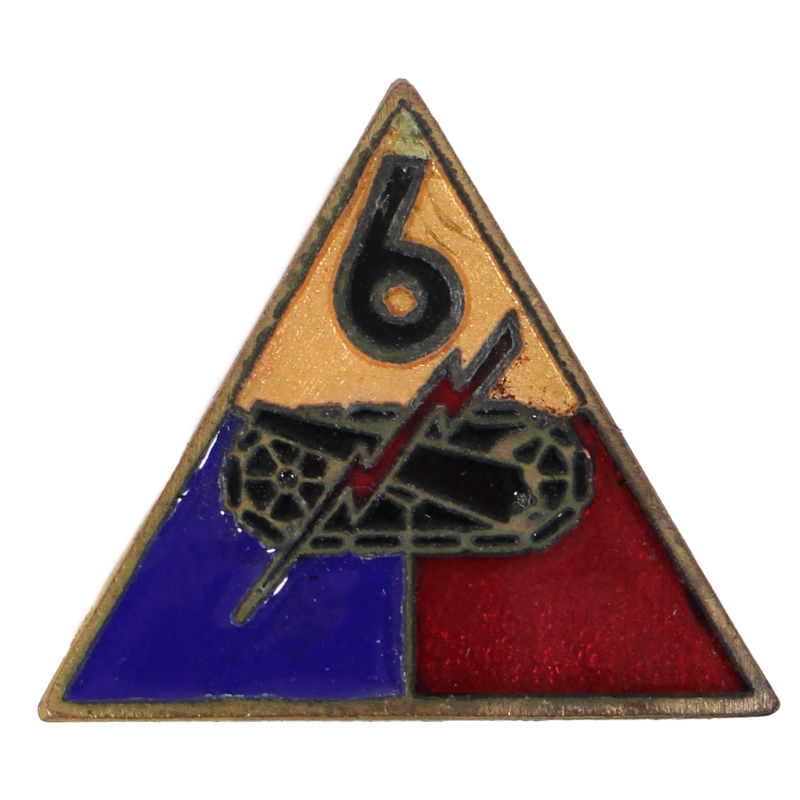
Genuine WWII enameled distinctive unit insignia of the 6th Armored Division 'Super Sixth'.
The 6th Armored Division fought in Normandy, Brittany, France, Battle of the Bulge and Germany.
Landing at Utah Beach at the end of the Normandy Campaign, 6th Armored Div. assembled at Le Mesnil, Manche on 25 July 1944. 6th AD overran Granville, on 31 July 1944, then returned to Avranches, where it relieved U.S. 4th Armored Division. In mid-August, the 6th Armored Division moved down to Lorient, where it was relieved by the 94th Infantry Division. Elements of the division participated in the Battle for Brest, then turned east and cut across France, reaching the Saar in November and established defensive positions in the vicinity of Saarbrücken. On 23 December, the division was ordered north of Metz to take part in the Battle of the Bulge. It was heavily engaged in the battle for Bastogne, finally driving the enemy back into Germany by late January 1945.
The historical artifacts for sale at PARATROOPER’s are intended for collectors, history enthusiasts, historians and museum curators. These items do not glorify or promote any of the political, ideological or racial opinions related to the global conflicts that bathed the 20th century in blood.
Besides, we remind you that Article R.645-1 of the French Penal Code establishes fines applicable to fifth class contraventions (except in the specific cases of a filming, show or exhibition which refer to historical events) for any individual who wears a uniform, insignia or symbol reminiscent of those worn by members of the various organizations declared criminal in application of Article 9 of the Charter of the International Military Tribunal annexed to the London Agreement of August 8, 1945 – SS, SD, Gestapo, Nazi leaders (the Führer, the Reichsleitung, the Gauleiters and their main collaborators, the Ortsgruppenleiter, the Zellenleiter and the Blockleiter), or reminiscent of those worn by any person found guilty, by a French or International Jurisdiction, of one or several crimes against humanity established by Articles 211-1 to 212-3 or mentioned in Law No. 64-1326 of December 26, 1964.
The Code provides additional penalties, including the confiscation of the items used or intended for committing the offence.