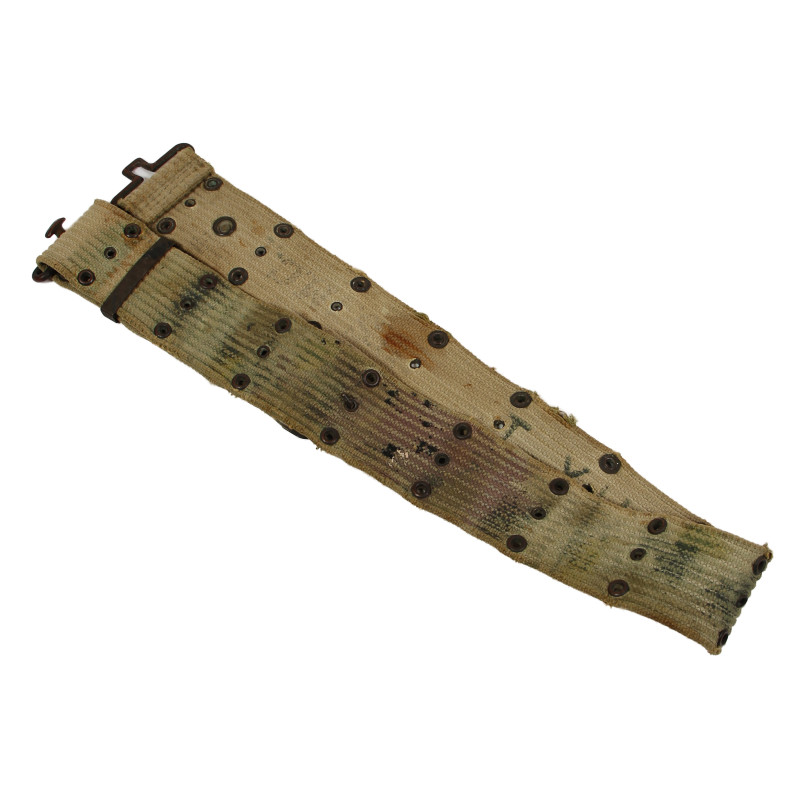
Genuine WWII USMC M1936 pistol belt, issued to medics and personnel armed with handguns, carbines or submachine guns; top row of grommets is designed for suspenders hooks, while bottom row is intended for securing various items of equipment thanks to bent-wire hooks.
The outer surface features an interesting theater-made, two-tone camouflage pattern (black and green paint), following a rather common habit amongst some US Marine Corps units deployed in the Pacific.
Worn condition; name T. Milo has been stenciled on the inner surface.
Teddy Milo was born on October 6, 1921 in Chicago, Illinois to Polish parents (Miloszewski) and joined the USMC in 1942. He went on to serve with Company E and Company D, 2nd Tank Battalion, 2nd Marine Division and participated in every major engagement his unit participated in, from Tarawa to Saipan, Tinian and Okinawa. He passed away on April 13, 2012.
The historical artifacts for sale at PARATROOPER’s are intended for collectors, history enthusiasts, historians and museum curators. These items do not glorify or promote any of the political, ideological or racial opinions related to the global conflicts that bathed the 20th century in blood.
Besides, we remind you that Article R.645-1 of the French Penal Code establishes fines applicable to fifth class contraventions (except in the specific cases of a filming, show or exhibition which refer to historical events) for any individual who wears a uniform, insignia or symbol reminiscent of those worn by members of the various organizations declared criminal in application of Article 9 of the Charter of the International Military Tribunal annexed to the London Agreement of August 8, 1945 – SS, SD, Gestapo, Nazi leaders (the Führer, the Reichsleitung, the Gauleiters and their main collaborators, the Ortsgruppenleiter, the Zellenleiter and the Blockleiter), or reminiscent of those worn by any person found guilty, by a French or International Jurisdiction, of one or several crimes against humanity established by Articles 211-1 to 212-3 or mentioned in Law No. 64-1326 of December 26, 1964.
The Code provides additional penalties, including the confiscation of the items used or intended for committing the offence.