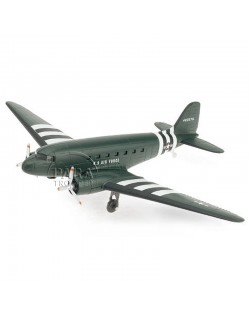
As part of the overall strategic planning for Operation Overlord, the code name for the Allied landings on the beaches of Normandy, the French village of Sainte-Mère-Église played a key role. On the battle plan maps, it was correctly identified as an important road junction that the Germans could have used to launch rapid counterattacks towards the Utah and Omaha beachheads. It was therefore strategically important to attack and quickly occupy the village with American airborne troops to support the landings. In the early morning of June 6, 1944, paratroopers from the famous 82nd and 101st US Airborne Divisions captured the small French town after intense fighting. These events have been recounted in numerous films, starting with “The Longest Day,” made in the 1960s.
This box set allows you to build a diorama representing the fighting at Sainte-Mère-Eglise. It includes a laser-cut wooden reproduction of the church, urban accessories, American paratroopers, German infantrymen, and a German Sd.KfZ.251 Ausf.C half-track.
The historical artifacts for sale at PARATROOPER’s are intended for collectors, history enthusiasts, historians and museum curators. These items do not glorify or promote any of the political, ideological or racial opinions related to the global conflicts that bathed the 20th century in blood.
Besides, we remind you that Article R.645-1 of the French Penal Code establishes fines applicable to fifth class contraventions (except in the specific cases of a filming, show or exhibition which refer to historical events) for any individual who wears a uniform, insignia or symbol reminiscent of those worn by members of the various organizations declared criminal in application of Article 9 of the Charter of the International Military Tribunal annexed to the London Agreement of August 8, 1945 – SS, SD, Gestapo, Nazi leaders (the Führer, the Reichsleitung, the Gauleiters and their main collaborators, the Ortsgruppenleiter, the Zellenleiter and the Blockleiter), or reminiscent of those worn by any person found guilty, by a French or International Jurisdiction, of one or several crimes against humanity established by Articles 211-1 to 212-3 or mentioned in Law No. 64-1326 of December 26, 1964.
The Code provides additional penalties, including the confiscation of the items used or intended for committing the offence.